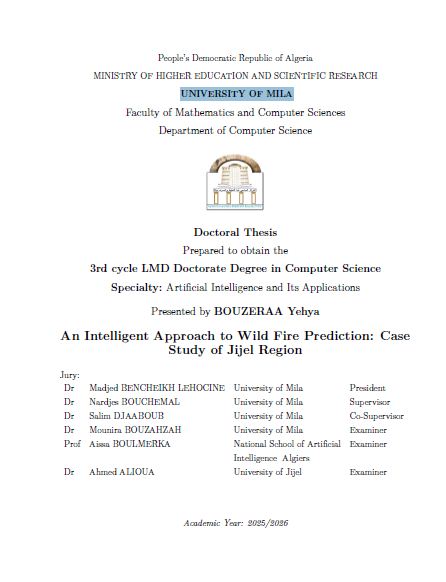
An Intelligent Approach to Wild Fire Prediction: Case Study of Jijel Region
Type doc. :
Langue :
Auteur(s) :
Année de soutenance:
Afficher le Résumé
Wildfires have intensified across the Mediterranean under compounding eatwaves, drought, and human pressure, making a shift from reaction to prevention essential. This thesis develops an operational wildfire susceptibility mapping (WSM) framework for Jijel Province (Algeria) that integrates Geographic Information Systems (GIS) and machine learning. Fourteen conditioning factorstopography (elevation, slope, aspect), climate (minimum, maximum, and average temperature, humidity, wind speed, precipitation), vegetation (Normalized Difference Vegetation Index, NDVI), and anthropogenic pressure (distance to roads and settlements)are harmonized on a 30,m grid and linked with civil protection fire records, yielding an analysis-ready matrix of approximately 2.6 million samples. Collinearity screening (maximum Variance Inflation Factor, VIF = 7.58; minimum tolerance = 0.11) and light k-means denoising of the Low class improve model stability. We train Random Forest (RF), Extreme Gradient Boosting (XGBoost), a shallow Neural Network (NN), and Support Vector Machine (SVM) models with class balancing and probability calibration. On the internal holdout set, RF attains an Area Under the Receiver Operating Characteristic Curve (AUC) of 0.99 and an F1-score of 0.98, with XGBoost and NN performing similarly, and SVM showing solid performance (AUC = 0.94). Continuous susceptibility scores are calibrated and discretized into five classes (LowVery High). Independent time-forward validation overlays wildfire occurrences from 20242025 (Civil Protection records and Moderate Resolution Imaging Spectroradiometer, MODIS, data) on the susceptibility maps: 87.73 The outputscalibrated probability surfaces, clearly legended risk classes, and uncertainty layersare suitable for integration into web-based GIS dashboards to support resource prepositioning, fuel-break maintenance at the wildlandurban interface (WUI), and thresholdbased early warning systems. Limitations (sparse meteorological stations and ignition geolocation uncertainty) and targeted improvements (denser in situ sensing and spatially blocked cross-validation) are discussed. The framework is transferable to similar Mediterranean environment
Télécharger Document
| N° Bulletin | Date / Année de parution | Titre N° Spécial | Sommaire |
|---|
| Cote | Localisation | Type de Support | Type de Prêt | Statut | Date de Restitution Prévue | Réservation |
|---|---|---|---|---|---|---|
| D.N004/02/1 | المكتبة المركزية / 1 | Electronique | interne | disponible |